


In recognition of a failed fact check published by Logically Facts and the subsequent comedy of errors it produced after my correction request, Zebra Fact Check submitted a formal complaint with the International Fact-Checking Network. We submitted the complaint early on Oct. 3, 2023.
Flub Up, Cover Up and Inexplicable Reversal at “Logically”
Dear IFCN staff,
On Aug. 14, 2023, I reviewed a fact check on the topic of fetal pain published by Logically Facts, listed as a verified signatory of the IFCN’s Code of Principles under the name “Logically.” That fact check was published on May 13, 2022.
The fact check used two citations relevant to its claim it is “False” that a fetus feels pain during an abortion procedure. Both were from before 2010. One contradicted the conclusion of the fact check, finding, as Logically’s fact check phrased it, fetuses “could experience pain somewhere between 29 and 30 weeks after conception.” The other citation, a secondary source transmitting the view of Dr. Stuart Derbyshire, expressed his view that the subjective experience of pain requires a level of consciousness not present until after birth. The fact check took Derbyshire’s view as factual, discarding without discussion the evidence from its other citation.
In my research, I quickly discovered that Derbyshire had reversed his position by 2020, well before Logically published its fact check. That’s something competent fact check research should have uncovered. Derbyshire’s reversal left the fact check with no reasonable support for its conclusion.
I submitted a correction request to Logically using the form it provides on its website. I cited Derbyshire’s reversal and pointed out the fact check relied squarely on Derbyshire’s 2006 paper. Logically promises a response to any complaint within 48 hours. After over a month I have no evidence Logically has made any attempt to contact me. But on the bright side Logically “revised” its fact check on Sept. 15, 2023. Unfortunately that so-called revision was highly misleading. Though itappropriately revised the conclusion to “Unverifiable,” it actively attempted to promote the false impression that its original version was consistent with the science in May 2022.
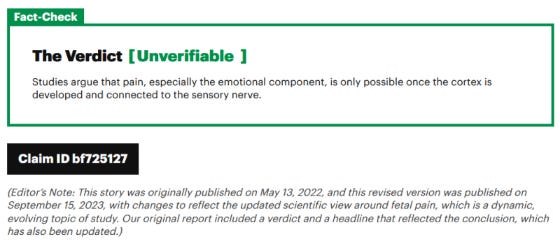
I submitted a second request to contact the editorial team at Logically (the first was to inquire as to why the 48 hour promise is apparently meaningless).
After noticing no corrective changes since that Sept. 25, 2023 attempt to discuss the issue with Logically’s editorial team, I started composing this formal complaint to the IFCN. And while documenting Logically’s incredibly poor handling of this entire issue, I discovered that the revised version of the fact check has been replaced with the original (horribly) flawed version.
My fondest hope is that this bizarre turn of events represents Logically’s latest attempt to appropriately fix the mess, albeit with a step appearing to lead in the wrong direction. Of note, this latest switching of the two versions bears no editor’s note informing readers of or explaining the changes to the article over the past month.
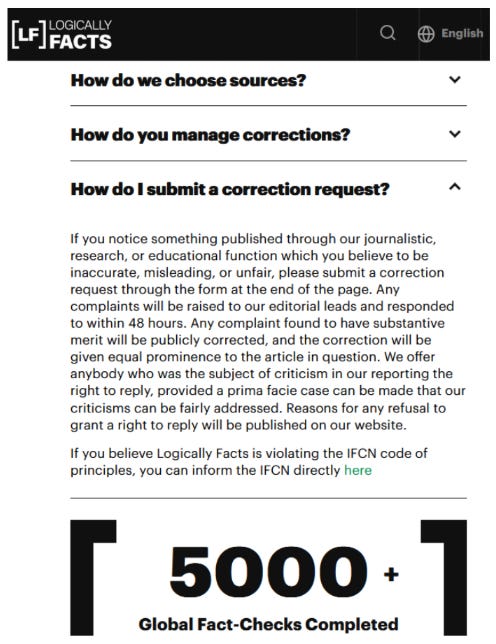
The fact check and the would-be corrective actions taken around this article by Logically Facts cannot jibe with any acceptable/ethical standard of practice in professional fact-checking. Sources should support a fact check’s conclusion. Sources should be primary and closely contemporary where possible and practical. Corrections should admit, explain and correct errors, transparently. Logically Facts spectacularly failed in pretty much every respect. A promise to respond to complaints within 48 hours (see image, right) counts as meaningless if there is no detectable response within 48 hours. Codes of practice should not make empty promises.
Thanks for taking the time to consider this complaint.
Lest the International Fact-Checking Network fail to realize it, formal complaints from Bryan W.White/Zebra Fact Check are intended as tests of the IFCN’s accountability system. IFCN performance, so far as it can be determined past the IFCN’s tendency toward unresponsiveness, has set a very poor record thus far.
Perhaps this reminder about the purpose of these tests will encourage more transparency from the IFCN.