

Our first formal complaint about PolitiFact to the International Fact-Checking Network was submitted via email on Jan. 26, 2018.
Dear International Fact-Checking Network,
Is the IFCN capable of ensuring its verified members uphold its statement of standards?
For your consideration:
On January 24, 2018, PolitiFact published a rating of the claim CHIP reauthorization would save the federal government billions. Specifically, House Democratic leader Nancy Pelosi said reauthorization of CHIP would save $6 billion over 10 years.
PolitiFact rated the claim “True,” relying on the Congressional Budget Office’s assessment:
According to CBO, “extending funding for CHIP for 10 years yields net savings to the federal government because the federal costs of the alternatives to providing coverage through CHIP (primarily Medicaid, subsidized coverage in the marketplaces, and employment-based insurance) are larger than the costs of providing coverage through CHIP during that period.”
The problem? CBO assessed that “employment-based coverage” represents revenue under CHIP renewal, not a cost savings.
A journalist’s sense should kick into gear at this point: Why does CHIP reathorization [sic] produce billions in revenue over 10 years? And given that(,) the $12.9 billion in revenue accounts for the $6 billion in savings Pelosi touted, doesn’t it mislead readers to tell them that CHIP costs less than alternative means of providing the services?
CBO chart (yellow highlights added)
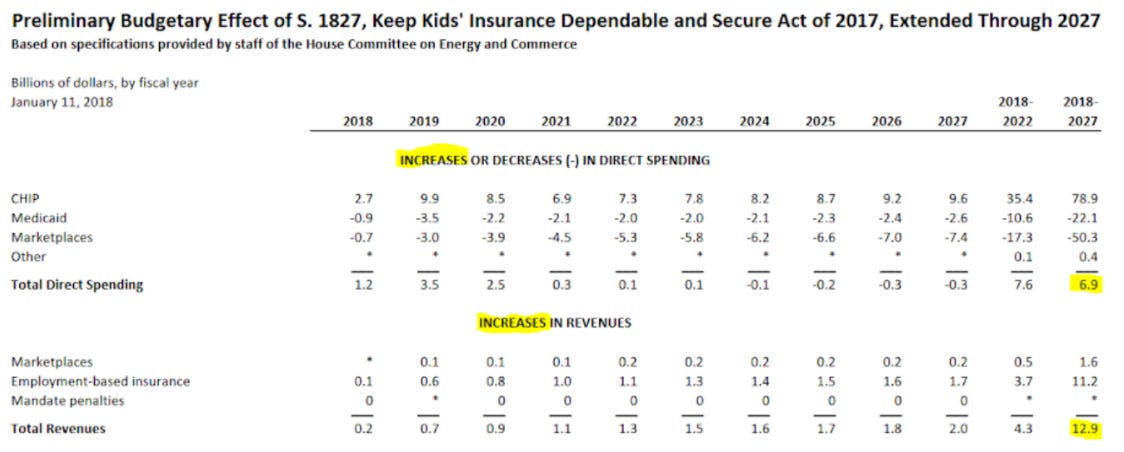
1) Readers deserve an explanation for the $12.9 billion in revenue that stems from CHIP renewal. Why does paying for children’s health care produce billions in revenue? And why is so much of the revenue ($4.2 billion) “off-budget”? Is CHIP drawing revenue from the Social Security program? If so, is that fact important to mention to readers?
2) Depending on the explanation for the $12.9 billion in revenue, it counts as misleading call the $6 billion budget surplus from CHIP renewal a “savings,” and doubly misleading to attribute the savings to lower costs for the delivery of care. Relying on a quotation from CBO counts as no excuse for the lack of journalistic curiosity. The fact check, in effect, leaves out critical details that might lead to a different impression.
It only makes this case more disturbing to note that PolitiFact has ignored communications calling attention to the problem.
Jan. 24 Twitter reply to @PolitiFact, tagging PolitiFact Executive Director Aaron Sharockman
Jan. 24 Twitter reply to writer Louis Jacobson
Jan. 24 Twitter tag of Jacobson’s editor, Katie Sanders, in threaded tweets to Jacobson
Jan. 25 email outreach to PolitiFact Editor Angie Drobnic Holan and Executive Director Aaron Sharockman
Instead of providing readers a valuable explanation of the counterintuitive fact that CHIP renewal produces billions in revenue over 10 years, PolitiFact rubberstamps a dubious political claim.
Hopefully, the IFCN exists to discourage that type of fact-checking.
In the interest of transparency, I look forward to hearing from the IFCN in reply.
Pre-republication update Feb. 22, 2026: We did receive acknowledgement from Director Alexios Mantzarlis, with qualified permission to publish. The qualification was time-based, and we have therefore met those qualifications.
It’s actually a somewhat long and meandering back-and-forth, available here.