

The title says it all, given that we’re posting a commentary article about this particular complaint.
PolitiFact Insists on an Indefensible Fact Check
Dear International Fact-Checking Network,
On July 20, 2023, PolitiFact published a completely botched fact check of Vice President Kamala Harris’ claim that new Florida middle school standards for Black history would teach “that enslaved people benefited from slavery.”
The standards direct that Black history will include “how slaves developed skills which, in some instances, could be applied for their personal benefit.”
It could not be more obvious that “slavery” and “skills (developed while enslaved)” are not the same thing. Yet that fallacious notion ultimately serves as the premise of the fact check instead of the object of the fact check.
The fact check follows the form of “He said, she said, they agree with him so he’s right.” There is no fact check of whether Florida’s standards teach that slaves benefited from slavery.
Paragraphs 1-4 rehash Harris’ claim.
Paragraphs 5-8 feature Republican pushback (calling Harris’ claim a lie).
Paragraphs 9-18 describe the law in question (with some minor errors).
Paragraphs 19-25 feature a defense of the standards by two of the authors, with biographical descriptions and one paragraph dedicated to pointing out tangential errors in a document they wrote in defense of the standards. The final paragraph contains a statement from one of the two, William Allen, who succinctly points out the error in Harris’ claim:
“They benefited from the skills, not the slavery,” Allen told PolitiFact.
The fact check never refutes or even attempts to rebut Allen’s explanation. The fact check assumes Florida standards say slaves benefited from slavery.
The next 11 paragraphs (26-37) recount the opinions of five experts PolitiFact contacted for comment. Paragraph 26 tells us that “multiple experts” said the standard in question “is misleading.” None of the quoted, paraphrased or summarized material supports that claim.
Marvin Dunn (Democrat donor) said “Most enslaved people had no special skills at all that benefited them following their enslavement.” That doesn’t appear to contradict the Florida standard at all (it says “at times” such skills served to benefit slaves). If that was true of a minority, even a small minority, that accords with the standard. Dunn said for “almost all” slaves “their skill was picking cotton,” a claim worthy of its own fact check. Dunn added that slavery removed the opportunities, but doesn’t explain how that would make the one isolated Florida standard misleading in any way.
Another Democratic Party donor, Katheryn Russell-Brown said one thing before my correction request and another thing after. Before my correction request, PolitiFact had Russell-Brown saying (allegedly paraphrased except where we can expect punctuation to show otherwise):
Russell-Brown said the standards offer “no discussion” of people who enslaved others.
After a “clarification,” that changed to the following:
Russell-Brown said the standards lack adequate discussion about the systemic racial issues that led people to enslave others.
I can imagine no possible way that Florida standards broadly missing that context would make the particular standard in question “misleading.” Russell Brown doesn’t explain how that would work. PolitiFact does not explain how that would work. The reasons behind enslavement shed no light on how noting the benefit to a slave from learning skills counts as misleading.
I will also note that the direct quotation “no discussion” seems hard to reconcile with the wording PolitiFact chose for its so-called “clarification.” On its face, it would seem Russell-Brown said something false and PolitiFact covered for her.
Bruce Levine, introduced by PolitiFact as “one of several scholars of the period who told PolitiFact that they rejected the value of spotlighting ‘skills’ learned while enslaved,” likewise had nothing to contribute to show that Florida’s standard was misleading. PolitiFact doesn’t publish its correspondence with experts as Zebra Fact Check does, but the quotation of Levine is nothing but a (fallacious) appeal to outrage: “Very simply, can you imagine saying this about ‘skills’ developed in Nazi forced-labor camps?”
Even if Levine’s outrage occurs in earnest, we cannot count it as evidence of the misleading nature of Florida’s Black history standard.
Carol Anderson’s expertise appeared to take for granted that getting benefit from skills while enslaved is pretty much the same thing as getting benefits from slavery itself. She offers no evidence supporting that apparent assumption, while also appearing to contradict Dunn’s claim about slaves’ skills almost completely limited to picking cotton:
“It has the racist underpinning of treating Africans as if they had no skills prior to being kidnapped from their homelands and trafficked to America,” Anderson said. “In fact, it was Africans’ skills in cultivating tobacco, sugar and rice that proved beneficial to the enslavers and built the inordinate wealth of the United States. The question itself is dehumanizing.”
Anderson’s words contribute nothing to the case that the Florida standard counts as misleading.
She’s another donor to Democrat politicians. Does PolitiFact seek out biased experts or what?
Finally, we have Ashley Rogers Berner, who likewise has nothing to say about how Florida’s standard misleads anyone: “It is not common for state standards to include language about the ‘benefit’ to enslaved persons of learning trades.” If it’s not common then it’s misleading? Is that the logic PolitiFact wants us to swallow?
Was Berner unaware that the College Board’s national standards for AP Black History contain a passage parallel to Florida’s, relating how slaves learned “specialized trades” and “used these skills to provide for themselves and others”?
And with that, the fact check moves to its conclusion. There’s no rebuttal of the defense mounted by two authors of Florida’s standards and no support of the allegation that the standard misleads. Moreover, there’s no fact check of whether the standard teaches that slaves benefited from slavery and not merely from skills learned while enslaved. There’s not a hint of the fact check we should have had after PolitiFact elected to examine Harris’ statement.
PolitiFact says Harris’ statement was “Mostly True” with no argument to back up its claim:
Our ruling
Harris said Florida “decided middle school students will be taught that enslaved people benefited from slavery.”
That is not the only lesson Florida students would be taught under the standards that also include many other aspects of Black history and slavery. But the one Harris cited is included, and has drawn significant criticism.
The middle school standards approved by the Florida state education board say students should learn about “skills” learned by slaves that could be “applied for their personal benefit.” Several historians who have studied slavery cast doubt on this lesson’s educational value.
We rate this statement Mostly True.
As noted above, ““He said, she said, they agree with him so he’s right.” That’s not fact-checking. It’s a travesty of logic.
I sent PolitiFact a correction request noting its central problem along with a few other problems. PolitiFact made a relatively minor change it called a “clarification” but otherwise seemed content with its work.
It doesn’t fact check the claim it purports to fact check, instead treating the truth of the claim as axiomatic while affording experts, four of five of whom have records of giving politically to Democrats, the opportunity to criticize Florida’s standard on dubious grounds.
If this case counts as meeting the IFCN’s standards for fairness, consistency of methodology and scrupulous adherence to an open and honest corrections policy, then the IFCN can expect public trust in fact-checking to continue to decrease. And those who distrust fact-checkers have excellent justification for their skepticism.
Code Violations
1 Commitment to Non-partisanship and fairness
A fact check that reaches its conclusion without the need for any argument whatsoever can never qualify as fair, and when it arbitrarily makes its judgment favoring the left when journalists tend to lean strongly left, the result appears frankly partisan.
The subrequirement of this principle states that the fact checker shall use the same high standards of evidence for equivalent claims regardless of the source of the claim. Choosing one group of experts over another without explanation can never meet that standard.
2 Commitment to Standards and Transparency of Sources
PolitiFact did a fine job of exposing the conservative ties of one of the experts defending Florida’s education standards. Readers were not informed, however, that four of five experts PolitiFact trusted for its final ruling had public record of giving to Democrats. At least one was also a Critical Race Theory advocate (also kept from readers).
3 A commitment to Standards and Transparency of methodology
A subrequirement of this Code requirement (listed as No. 4 on the IFCN list) says “5.3 The applicant sets out in its fact checks relevant evidence that appears to support the claim as well as relevant evidence that appears to undermine it.” As noted above, the fact check does not fact check the claim at all. It quotes an advocate of Florida’s standards saying that Harris’ claim is false based on basic language interpretation (skills learned while enslaved are not the same thing as slavery itself), then the fact check never addresses that point and subsequently issues a ruling that treats skills learned while enslaved as though they are slavery itself. The latter point occurs without supporting argument. That method can never count as a high standard in the realm of fact-checking. Indeed, it’s hard to see how it could count as a meaningful standard at all.
4 A commitment to an Open & Honest Corrections Policy
After receiving a correction request, PolitiFact left its most egregious errors intact, making only one minor change in a less-than-transparent manner (as described above). The “clarification” failed the test of openness, for it created a discrepancy between its updated “paraphrase” and the quotation embedded in its earlier “paraphrase.” I put “paraphrase” in scare quotes because it is not apparent that PolitiFact distinguishes between paraphrase and summary.
Also, subrequirement 6.3 states (bold emphasis added) “Where credible evidence is provided that the applicant has made a mistake worthy of correction, the applicant makes a correction openly and transparently, seeking as far as possible to ensure that users of the original see the correction and the corrected version.” PolitiFact changed a false statement from one of its experts (or at least its summary/paraphrase of that expert) into an irrelevant statement and called it a “clarification.” As for PolitiFact’s effort to ensure that readers saw the clarification, that’s up to the reader to look for and find “Corrections” in the top menu of PolitiFact’s website, click the link and actively look for the corrected version of the story.
I’ve never understood how that method can meet the listed standard. At my website zebrafactcheck.com I set up a system that might meet the standard (our method predated the IFCN Code of Principles). Significantly corrected stories go in the main feed of posts in the form of a post thoroughly explaining the error and how it was corrected. The “Corrections” tab appears prominently on the main menu.
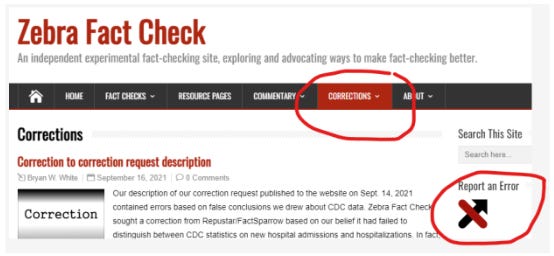

Forcing readers to hunt for corrections should never count as “seeking as far as possible to ensure that users of the original see the correction and the corrected version.” Placing explanatory corrections in the main story feed may meet that standard.
We want standards that mean something, don’t we?