


AFP Fact Check committed the same equivocation error other fact-checking organizations have committed while attempting to answer whether (elective) abortion can sometimes prove medically necessary. The failure either of AFP Fact Check’s correction request interface or else its desire to correct error count as a failure to scrupulously adhere to an open and honest corrections policy, hence our complaint submitted to the International Fact-Checking Network on Aug. 5, 2022.
Dear IFCN,
Agence France-Presse published a fact check on abortion containing an equivocation fallacy. The attempt to obtain a correction produced both confirmation and failure messages, leaving uncertainty about whether the message was received. A follow-up communication (via Twitter) directed at an AFP Fact Check editor, Daniel Funke, produced no response.
Equivocation
AFP Fact Check used an equivocal argument similar to the one other mainstream fact-checking organizations have used. The July 8, 2022 fact check takes “abortion” used in the sense of elective abortion (or the term “anti-abortion”) and tries to contradict a claim containing that sense of the term with a different sense of the same term. The image (right) used in AFP Fact Check’s fact check defines “abortion” as elective abortion (blue underlining added for emphasis).
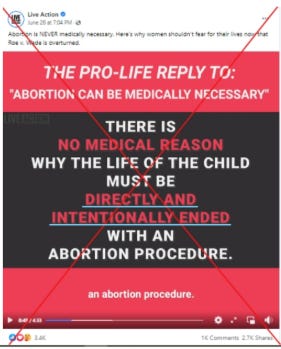
The supposed contradiction drops the “directly and intentionally ended” language entirely. The fact check says “medical experts told AFP the claim is a distorted, inaccurate understanding of what abortion is -- and it does not reflect the scientific consensus that abortion is sometimes medically necessary.”
The medical experts do not show that the claim uses “abortion” incorrectly. They simply equivocate, and a fact checker should recognize and expose equivocation instead of promoting it (the link leads to a discussion of different definitions of “abortion”).
Fact-checking the embedded image should require examining whether there is a medical reason for “directly and intentionally” ending the life of the embryo/fetus. Doing otherwise means the fact checker has taken the claim out of context.
The result of AFP’s fact check relies on a fallacy of equivocation.
Correction Dead End?
I cannot say with certainty that AFP Fact Check received my correction request. My attempt to submit a correction request showed a confirmation message and an error message.

I saved an image of the form before submitting it:
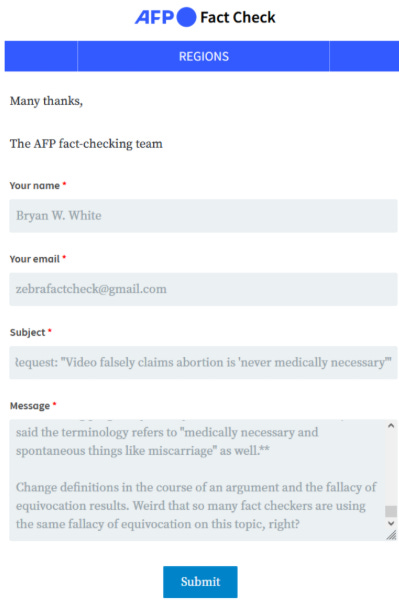
If AFP Fact Check never received the correction request, then this shows a failure of an open and honest corrections policy based on a faulty interface and lack of response to the complaint about the faulty interface.
If AFP Fact Check received the correction request and did nothing to fix its fallacy of equivocation, then this likewise shows a failure of its corrections policy.
Note: This post at Zebra Fact Check contains the full text of the attempted complaint submission to AFP Fact Check.
Thanks for your attention to this matter.