

When we could not see any attempt from PolitiFact to fix a fact check containing three instances of statements taken out of context, we submitted the case to the International Fact-Checking Network as an example of PolitiFact failing to uphold its commitment to fact check fairly.
Here’s the text of the complaint:
PolitiFact Health Check Uses Out-of-context Quotations to Create Misleading Narrative
PolitiFact’s published statement of principles does not offer its fact-checkers explicit guidance for respecting the context of political claims. It does, however, implicitly recognize the wrongness of taking claims out of context. We find that implicit recognition in PolitiFact’sdefinition of the “Half True” “Truth-O-Meter” rating:
HALF TRUE – The statement is partially accurate but leaves out important details or takes things out of context.
PolitiFact says taking things out of context makes them “Half True” (perhaps an understatement).
But it’s clear, on examination, that a PolitiFact Health Check published on March 18, 2020 took two short quotations out of context to create a misleading impression about President Trump.
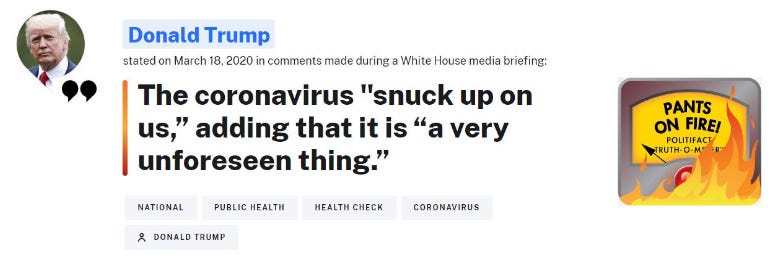
“Snuck Up On Us”
PolitiFact said Mr. Trump excused poor U.S. preparedness for the coronavirus by arguing the coronavirus came as a surprise (bold emphasis added):
In particular, the president defended his administration on the issue of insufficient testing resources and what experts say is a looming shortage of medical equipment and personnel.
His argument? No one saw this coming.
“It snuck up on us,” Trump said at a March 18 media briefing. Later, he added that the virus is “a very unforeseen thing.”
Note that PolitiFact presents the other quotation, “a very unforeseen thing” in the same context, as an excuse for poor overall preparedness. I’ll address the misuse of the quotations in order.
Though PolitiFact says it publishes a list of sources with every fact check, it failed to list the March 18, 2020 media briefing on the list. Nor was the briefling hotlinked in the article.
The March 18, 2020 Media Briefing
How did Mr. Trump use “It snuck up on us” during the media briefing (highlights mine)?
In Mr. Trump’s statement he does not simply emphasize that the coronavirus itself “snuck up on us.” Very clearly in the context of his statement he emphasizes the ease of transmission. Givenearly reports regarding a lack of evidence of human-to-human transmission and the recentrealization that the virus spreads surprisingly well in pre-symptomatic carriers, the president’s statement seems reasonable. The fact check entirely ignores both those aspects of viral transmission. As a result, the fact check takes Trump’s statement out of context.
“A very unforeseen thing”
How did Mr. Trump use the phrase “a very unforeseen thing”?
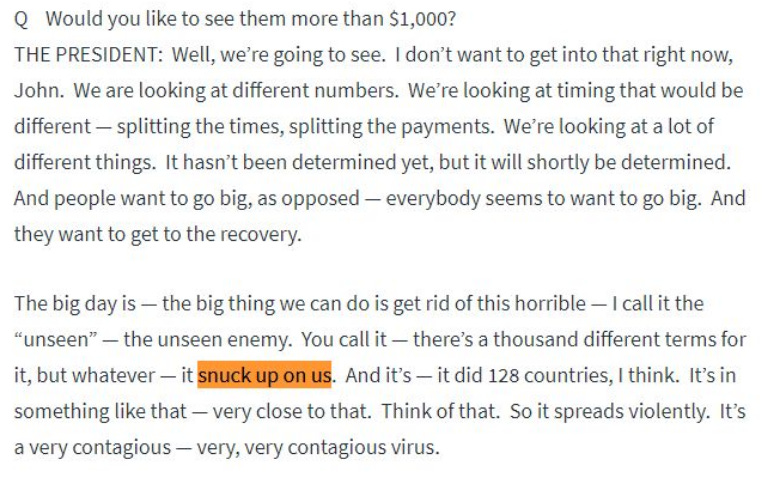
In context, Mr. Trump was talking about an unforeseen need for huge numbers of ventilators, not about an unforeseen virus. And, in retrospect, the preparedness on ventilators appears to have matched the need.
PolitiFact took those two phrases out of context and created a sensational and misleading fact check out of them. It’s worth reviewing the headline PolitiFact used: “The coronavirus ‘snuck up on us,’ adding that it is ‘a very unforeseen thing.’”
The fact check focuses on wide public knowledge, including among experts, that the novel coronavirus was known for its potential as a global pandemic. That was not the context in which Trump said it “snuck up on us” and called it “a very unforeseen thing.” “Snuck up on us” referred to the virus’ surprising ease of transmission (apparently owing to transmission by presymptomatic carriers). That surprising mode of transmission helps explain the growth of this particular pandemic. “A very unforeseen thing” referred to the high demand for ventilators, though the demand appeared higher at that time than it turned out in reality. One could also reasonably say Trump included the demand for masks in his statement. Whether or not the administration had adequate warning on the need for protective masks, PolitiFact did not examine the statement in that context.
Fact-checking journalists should handle quotations with the utmost care, not with the carelessness of the supermarket tabloids. This example shows a failure of the commitment to fairness and impartiality.
Amazingly, the fact check contains yet another example of a quotation taken out of context (bold emphasis added):
Public health researchers have been warning for years about the threat of a pandemic. And members of his administration have been sounding the alarm for months now –even while, just earlier this month, Trump was still comparing the virus’ severity to the flu, and arguing that it “will go away” if people “stay calm.”
It’s adequately documented that Mr. Trump has said the virus will go away. It is likewise adequately documented that Mr. Trump has advised people to stay calm. Mr. Trump has never, to our knowledge, connected the two propositions with an if/then statement.
I would call that coupling of quotation snippets fact check fabulism.
Thanks for your attention to this matter.
Sincerely,
Bryan W. White
Editor/Publisher
Zebra Fact Check
May 20, 2020