

A PolitiFact fact check got out ahead of the facts, evident after Uvalde, Texas law enforcement issued contradictory reports about events surrounding a shooting incident. PolitiFact obscured from readers that it issued apparent false reports while relying on official sources. Instead of admitting it changed its reporting, PolitiFact told readers it updated its story with new information that came out after its story published. PolitiFact resisted requests that it follow its statement of principles with respect to the changes it made to its story.
Zebra Fact Check reported the case to the International Fact-Checking Network as an example of PolitiFact failing to scrupulously adhere to an open and honest policy on corrections.
Is an Update What PolitiFact Says It Is?
PolitiFact’s policy on corrections and updates features a number of details. As a result, PolitiFact may find a variety of ways to act contrary to the principles it espouses. Zebra Fact Check has shared with the International Fact-Checking Network a fair number of cases where PolitiFact simply failed to act to correct an obvious error. In other cases, PolitiFact will perform a correction, clarification or update without following the procedure outlined in its statement of principles.
This case counts primarily as the latter.
In a May 26, 2022 fact check of a claim from Ted Cruz about the efficacy of armed guards in safeguarding schoolkids, PolitiFact used the Uvalde, Texas shooting incident as its lead example in its attempt to contradict Cruz’s claim:
Whether it’s anecdotal evidence or broad-based research, there is little to support Cruz’s claim. Let’s start with what happened in Uvalde, Texas.
Uvalde shooter confronted by school officer
But the same day as the story published, Texas authorities issued statements placing in doubt the descriptions PolitiFact used to undercut Cruz. Those statements prompted PolitiFact to make changes to its fact check. PolitiFact deleted material, changed existing material and added new material, marking the changes mid-text as an update (“Updated on May 26”).
But the multiple changes PolitiFact made do not appear to match the way it describes updates in its declaration of principles:
Updates – From time to time, we add additional information to stories and fact-checks after they’ve published, not as a correction but as a service to readers. Examples include a response from the speaker we received after publication (that did not change the conclusion of the report), or breaking news after publication that is relevant to the check. Updates can be made parenthetically within the text with a date, or at the end of the report. Updated fact-checks receive a tag of “Corrections and updates.”
The above description strongly implies PolitiFact will identify newly added update material in one of two ways: either parenthetically within the original text marked with the word “Update” or else after the end of the original story, demarcated with an “Update” announcement. Our example nods at the first option, though changes to the story precede the embedded announcement of the update. The short story summary went from three items to two items, for example. And, of course, PolitiFact made all of its text additions without the benefit of parentheses to clue readers to where the material was added.
On May 27, 2022, I noticed the way this update failed to jibe with PolitiFact’s statement of principles and sent PolitiFact a message asking it to ensure that its changes were made in accord with its statement of principles. I sent that message at 1:46 p.m. EDT. The Internet Archive capture from 17:25:12 (UTC; 1:25 p.m EDT) shows the page with the mid-text update. The next viewable capture, after we asked for the correction, shows a 21:09:16 UTC timestamp (5:09 p.m. EDT). That capture shows the update notice moved to the end of the fact check. But PolitiFact offered readers no acknowledgment that the update did anything other than supplement the old article with new information. That obviously was not the case. These screen captures from the Internet Archive Wayback Machine show some of the changes PolitiFact made to its story.
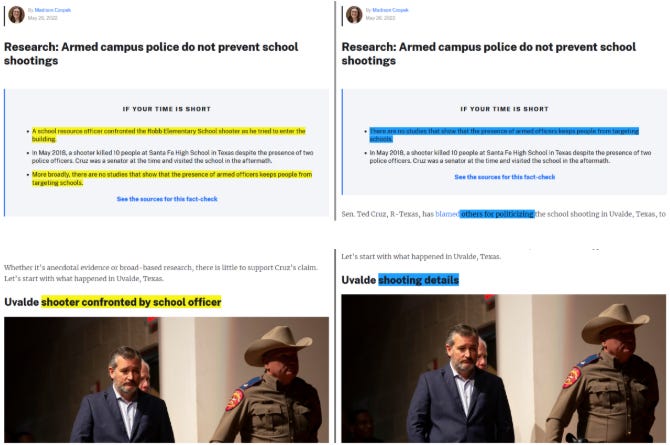
.
[As the above image shows,] PolitiFact deleted a summary line stating a school resource officer confronted the shooter as he tried to enter the building, and altered a subheader that made a similar claim. Those changes count as corrections under PolitiFact’s set of principles, not updates.
Note PolitiFact’s policy on corrections:
Mistakes happen. PolitiFact corrects errors as quickly as possible and with appropriate transparency. Readers and others can bring errors to our attention by emailing truthometer@politifact.com or contacting the individual reporter. We may not respond in cases where the request for correction is baseless or unwarranted.
Major errors of fact – A serious error that results in a new rating or otherwise changes the general outlook of the fact-check receives a mark of correction at the top of the fact-check.
The text of the fact-check is updated with the new information, and an archived copy of the previous fact-check is preserved and linked to. Additionally, the link text for the item is marked as updated. Corrected fact-checks receive a tag of “Corrections and updates.”
Errors of fact – Errors of fact that do not impact the rating or do not change the general outlook of the fact-check receive a mark of correction at the bottom of the fact-check.
The text of the fact-check is updated with the new information. The correction states the correct information that has been added to the report. If necessary for clarity, it repeats the incorrect information. Corrected fact-checks receive a tag of “Corrections and updates.”
PolitiFact changed two lines in its report after new information contradicted the sources it had used as their basis. Those changes count as errors of fact, so the latter guideline from PolitiFact’s statement of principles ought to apply. PolitiFact should have used an editor’s note to inform readers it updated and corrected its story. As well, PolitiFact should have informed readers that it failed to follow policy by referring to the variety of changes to its story as an update.
I sent PolitiFact a second correction request on May 31, 2022, noting that it had failed to properly act in response to my first request and asking it to correct the story again to bring the changes in line with its statement of principles. As of June 8, 2022, PolitiFact had taken no new discernible action to bring its actions in line with its statement of principles.
It’s worth noting that PolitiFact’s commitment through the International Fact-Checking Network’s statement of principles obligates PolitiFact to make every practical effort to make its readers, particularly those who read the first version of its Cruz fact check, aware of the new version of its fact check. Beyond the existence of a drop-down menu that includes a “Corrections and Updates” hotlink leading to a page of updates stories, I am aware of no steps PolitiFact takes to ensure compliance with that part of the IFCN Code of Principles.
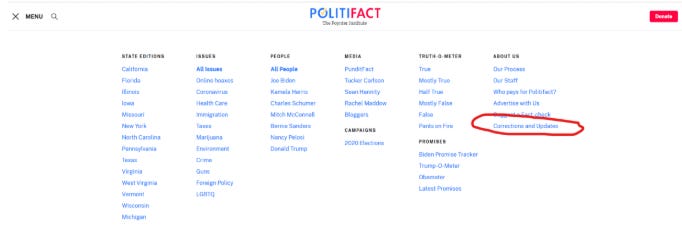
I would describe that as a weak effort, at best, to bring corrected stories to the attention of readers. For contrast, the design of my Zebra Fact Check site places a correction announcement post (these) in the main story feed, describing the mistake, how it was fixed and linking in turn to the corrected story. I don’t know how anything less than that could properly meet the IFCN standard.

Perhaps the IFCN holds that placing a “corrections and updates” URL on an out-of-the-way part of a drop-down menu properly meets the standard. If so, that should enable organizations with low standards to meet the IFCN’s high standards(?) with very little effort.
To summarize, PolitiFact’s attempt to update its flawed Ted Cruz fact check appears to improperly combine corrections with updates in a way that makes it hard for readers to tell what changed and why. For full transparency, PolitiFact should have admitted it changed its reporting, beyond the mere addition of information, in light of new information. And those changes were corrections and not updates (as PolitiFact defines those).
PolitiFact did not scrupulously follow its policy on corrections.