

On May 26, 2020 Zebra Fact Check followed up on its correction request submitted to PolitiFact by lodging a formal complaint about PolitiFact to the International Fact-Checking Network.
The complaint suggests that PolitiFact’s failure to abide by its own principles for purposes of a Truth-O-Meter rating fail the IFCN Code of Principles on the issue of fairness. Further, PolitiFact’s failure to correct the obvious inconsistency results in a breach of the IFCN standard calling for scrupulous observance of its corrections policy.
PolitiFact’s mistake remained uncorrected as of March 11, 2020.
PolitiFact Pennsylvania’s Method Contradicts PolitiFact’s Principles But No Correction
A PolitiFact Pennsylvania fact check from May 14, 2020 contradicts PolitiFact’s statement of principles with the justification it offers for its rating.
PolitiFact has long claimed to based its “Truth-O-Meter” ratings on information available at the time a political claim was made. PolitiFact’s latest iteration of its statement of principles maintains that stance (bold emphasis added):
The burden of proof is on the speaker, and we rate statements based on the information known at the time the statement is made.
But the “False” rating meted out to Pennsylvania Republican Mike Turzai for a claim he made on May 9, 2020 was based on two lines of evidence that surfaced on May 11, 2020.
First, note PolitiFact Pennsylvania’s summary of its reasoning (bold emphasis added):
Our ruling
Speaking about the coronavirus, Turzai said children are “not at risk unless they have an underlying medical issue.” A new study and a growing number of gravely ill children in New York City prove otherwise. We rate this statement False.
Review the date PolitiFact gives as the date Turzai made his claim (May 9, 2020).
The “new study” was new indeed. It was published on May 11, 2020.
PolitiFact went on to relate how news on “a growing number of gravely ill children in New York City” came out the same day as the May 11, 2020 study:
Publication of the study came the same day New York City officials announced that a growing cluster of children sickened with the coronavirus have developed a serious condition called pediatric multi-symptom inflammatory syndrome.
So both lines of evidence used to give Turzai’s claim a “False” rating came out after Turzai made his claim.
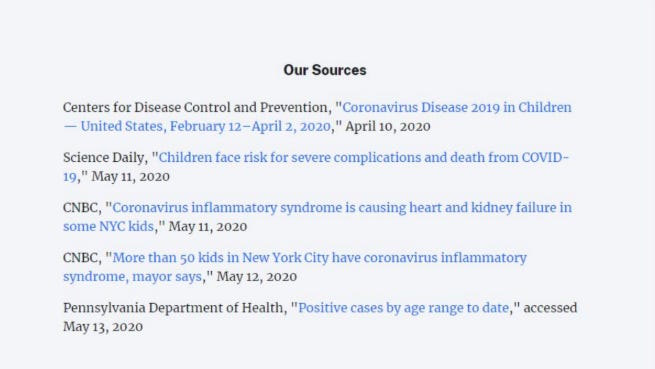
PolitiFact’s source list affirms the timing of its key lines of evidence, with both publication dates listed as May 11, 2020:
Though the evidence PolitiFact Pennsylvania ignored PolitiFact’s principles could hardly come through more plainly, I had no luck persuading PolitiFact to run either a correction or a clarification.
I used Twitter to try to draw attention to the issue, and submitted a more formal correction request to the recommended “truthometer@politifact.com” email address. A week after submitting the correction request PolitiFact Pennsylvania had made no recognizable move to bring its work in line with PolitiFact’s statement of principles. Nor had PolitiFact amended its statement of principles to justify the method employed by PolitiFact Pennsylvania.
This case shows two ways PolitiFact failed to follow the IFCN Code of Principles. First, it failed to treat Turzai fairly by following its own statement of principles (2.1). Second, it failed to exhibit what we should expect of scrupulous adherence to an open and honest corrections policy (6.3). Honesty ought to guarantee PolitiFact’s recognition that PolitiFact Pennsylvania did not follow PolitiFact’s stated methodology. And that recognition should have resulted, at minimum, in a change to the justification PolitiFact used in its grading of Turzai’s claim.
Thanks for your attention to this matter.