


In August 2022 Zebra Fact Check sent an email to the International Fact-Checking Network and Poynter Institute president Neal Brown asking why the IFCN does not answer our inquiries (giving two examples). A long email exchange eventually ensued, which we document here with the exception of one email specified as off-the-record and our response to that email. We are not publishing our response solely to avoid providing hints about the off-the-record content.
We will later attempt to summarize the exchange and analyze its meaning.
Pre-republication update Feb. 21, 2026: In republishing material we often update links. In this exchange I took the unusual step of updating links embedded in Enock Nyariki’s messages. Not doing so may have left details incomprehensible to the interested reader.
I ZFC (Aug. 25, 2022)
Dear International Fact-Checking Network and Neil Brown,
In the interest of transparency, please explain why you decline to answer emails such as this and this.
The public ought to have a better view of what goes on at the IFCN. Why so much resistance to my inquiries?
Thanks!
II IFCN (Aug. 25, 2022)
Hi Bryan,
It’s Enock Nyariki, IFCN’s community and impact manager.
I hope you’re doing well.
Please let me know if you have questions about the global fact-checking community and their work in fighting false information. You can also direct any IFCN-related inquiries to me.
Thank you!
Best,
Enock Nyariki
Community and impact manager
The International Fact-Checking Network
@enocknyariki | @factchecknet
On Thu, Aug 25, 2022 at 1:39 PM Baybars Orsek <baybars@poynter.org> wrote:
We need to respond to him..
[Quoted text hidden]
--
Baybars Örsek
Director | International Fact-Checking Network
@baybarsorsek / @factchecknet
III ZFC (Aug. 27, 2022)
Hi Enock.
You don’t know how delighted I am to receive your email, especially if it means somebody I emailed deliberately shared my outreach message with you.
As before, I am asking questions with the aim of improving IFCN transparency. The IFCN publishes too little explaining its processes and activities. I need answers I am allowed to publish, and even better if they’re attributable.
I was in the process of writing an article where I try to guess at the legitimate reasons the IFCN might have for not answering many of my emails over the years. I can probably spike that article (or at least greatly rework it) if I get the answer straight from the IFCN.
1) Why has the IFCN typically refrained from answering email inquiries from zebrafactcheck@gmail.com?
2) In the first of the two ignored message examples I used as examples in my most recent outreach to the IFCN, I noted that a PolitiFact fact check supported a complaint I made about a 2019 IFCN fact check review (via “outside assessor”). Science Feedback/Climate Feedback said abortion is unequivocally used to treat ectopic pregnancy. PolitiFact said it wasn’t so clear, quoting a doctor who performs the procedure as saying she never thought of it as an abortion. The outside assessor found no problem with the fact check apart from citing biased experts. This points up a problem with the review process as it existed at the time. And, as noted in my email, that situation is hardly improved if Science Feedback itself now bears responsibility for adjudicating its own fact check decisions. Does the IFCN acknowledge flaws in the 2019 review, and does it have any specific plans to improve the review process where the challenged fact checks may result in social media censorship?
My thought is to add these Q&A’s to this series graciously enabled by former IFCN director Alexios Mantzarlis. I’ll rebrand it as Q&A with the IFCN with your permission. Also with your permission, I will make emails (starting with the one I’m writing now) in this series available to readers, as written, as non-indexed (for search engine purposes) resource pages. It’s part of my very serious approach to radical transparency.
Of course you may ask that I keep portions of your responses off-the-record and I will honor that by blocking out those parts of the emails.
Like so, except that with a .pdf file block overlay it won’t be possible to read it simply by highlighting the text with the cursor.
Thanks! Have a great remainder to your weekend.
IV ZFC (Sept. 2, 2022)
Hi Enock!
Just checking in to confirm whether you received my message and whether there’s any way I can modify my questions to assist your attempts to answer them.
Have a great weekend!
V IFCN (Sept. 2, 2022)
Hi Bryan,
Thanks for the reminder.
I initially missed your earlier email. I started working on a response yesterday. I’ll send it to you this afternoon.
Thank you!
VI IFCN (Sept. 2, 2022)
Hi Bryan,
I am so sorry this email fell through the cracks. I usually respond within a day or two.
From now on, email me directly if you have any complaints or questions. I’ll do my best to answer, or direct you to people who’ll be best placed to respond.
Now, straight to your questions:
1. I am not aware of the emails from zebrafactcheck@gmail.com. If you want me to respond to the issues you raised, please forward me those email inquiries. As you might know, we receive hundreds of emails daily, and some may fall through the cracks. We do our best to reply to serious inquiries at the earliest opportunity.
Regarding specific complaints, IFCN doesn’t intervene. Those are handled by the signatory & any statutory press regulation body it may be signed up to in its own country.
When users feel that a signatory has made a serious violation of the code of principles, they’re welcome to submit a complaint. The IFCN director and advisory board act on those that have merit.
See more on our Complaints Policy.
2. Requests to make corrections to fact-checks are sent to specific signatories. You could visit the organization’s website to get the particular channel to use, or I can help you get that. All members of the network commit to an open and honest corrections policy. If the issue is serious and remains unresolved, an independent assessor will examine it and recommend it accordingly.
Let me know if you have further questions.
Have a wonderful weekend.
Thank you
VII ZFC (Sept. 3, 2022)
Dear Enock,
Thanks for starting to address my two questions. I am numbering my responses to correspond to the issues associated with each question. As to the first question:
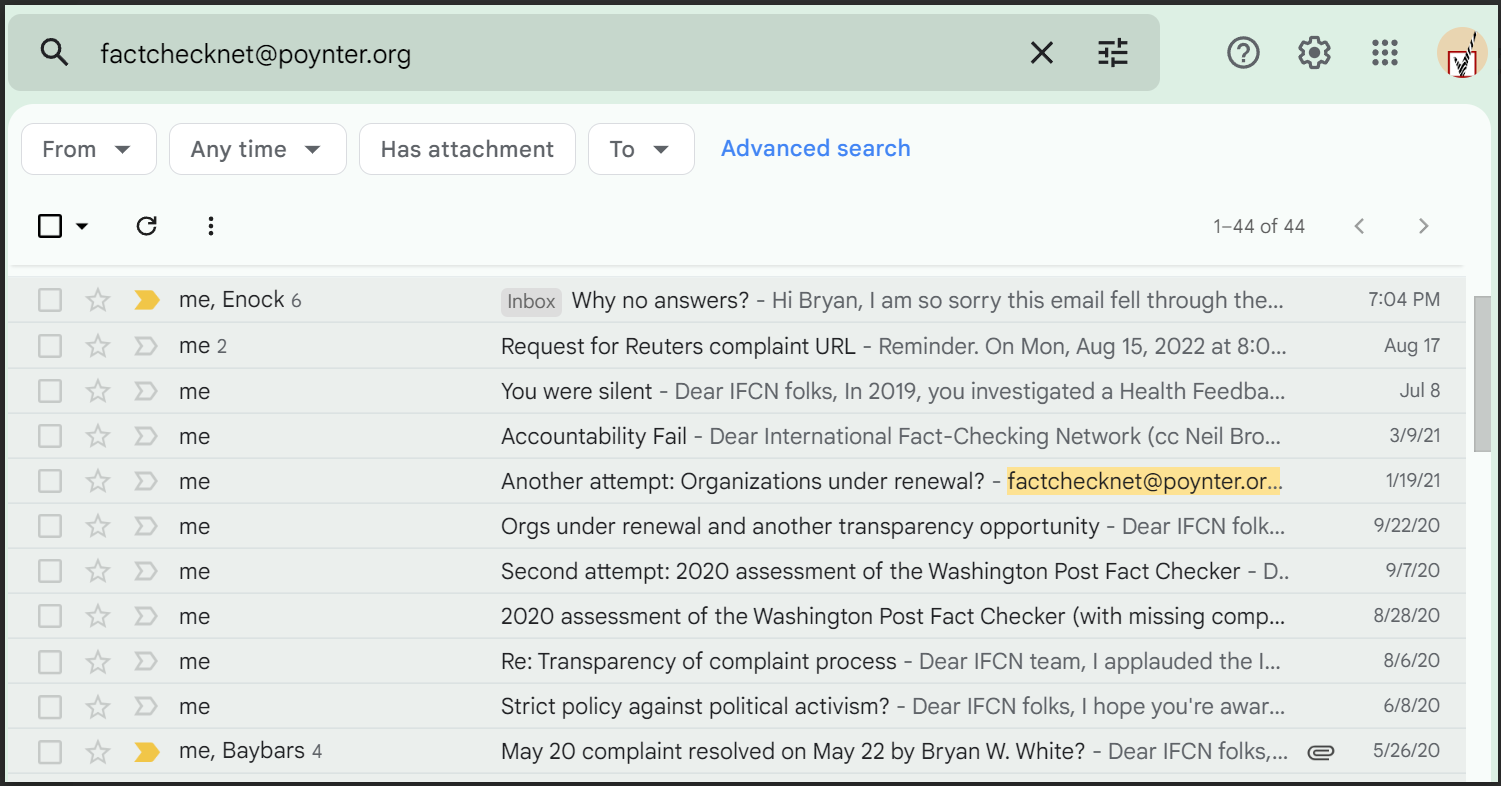
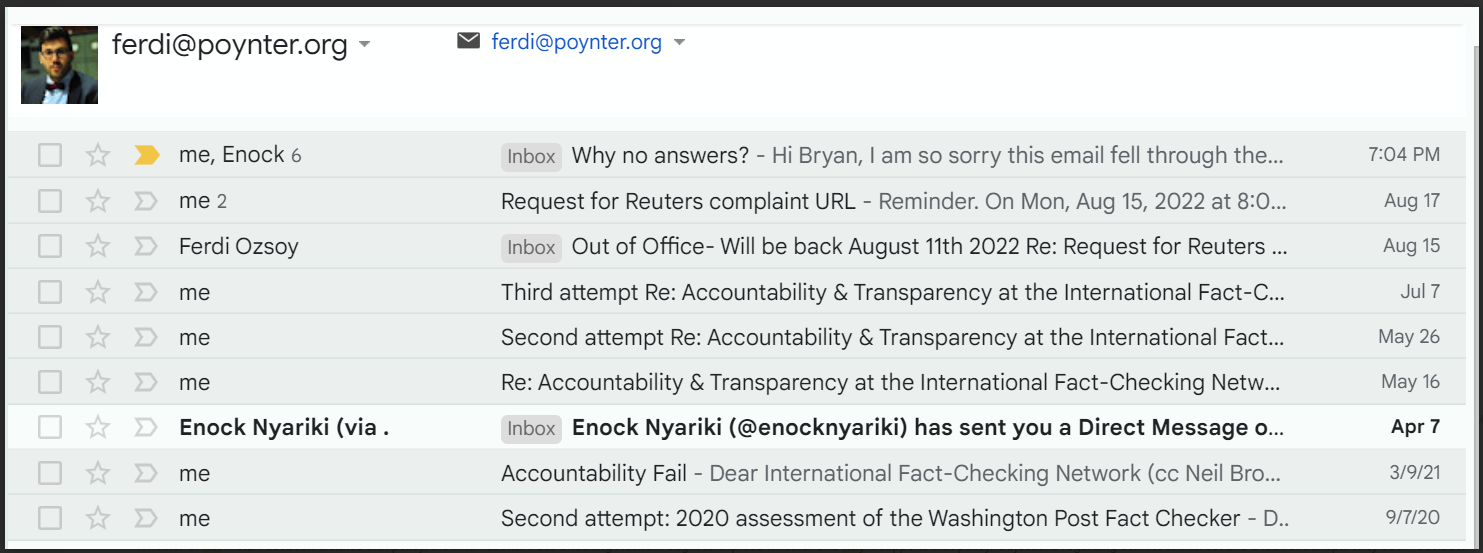
1) I appreciate your offer to address the issues I raised in earlier emails. But doing so will not answer for me the question as to why the questions were not answered in the first place. That’s an important question touching the issue of transparency. If, for example, the IFCN is literally too busy to address serious questions about its operations, publicizing that difficulty may inspire a benefactor to step in and fund the needed labor. I am simply looking for the explanation the IFCN would put forward for not answering past emails. With my gmail account I can use the search bar and find each of the messages I have sent to the IFCN or emails I received from a given address. It seems safe to assume one with access to the main IFCN account can access any email I sent to the IFCN, assuming it wasn’t deleted. I’ll attach screenshots to show the one-sidedness of my interactions with the IFCN over the past two years or so. This is not to say the situation was much better before that. You may have to ask somebody with more history at the IFCN, such as Ferdi, why the emails went unanswered. Perhaps you will not be able to obtain an answer. In that case, I’ll have to accept the report that you could not obtain an answer to the question. I’ll report what I hear from you, for that is all I can do regarding my effort to provide transparency.
2) On this question perhaps I skimped too much on the background. I apologize if I am guilty of providing too little information to enable you to answer the question. I am aware of the existing system for challenging the determinations of social media fact check partners. It was not always as it is today. The 2019 IFCN review I linked in my earlier email was an IFCN attempt to resolve a disputed fact check. The IFCN itself, through the work of one of its outside assessors, found Science Feedback at fault in that case for using biased sources. The IFCN’s ruling resulted in the nullification of sanctions against the Facebook account of Young America’s Foundation. At the time, I pointed out the outside assessor had erred in judging the fact check accurate aside from its faulty use of biased sources. The fact check unequivocally assured its readers an ectopic pregnancy treatment counts as an abortion. At the time, I had challenged the slipshod and shifting definition of “abortion” in the Science Feedback fact check. A recent PolitiFact fact check article found doctors saying they do not consider treating an ectopic pregnancy an abortion. As that finding dovetailed with my criticism of the original ruling, I asked the IFCN to acknowledge its flawed ruling. You may rest assured that Science Feedback would have shown no greater inclination than did the IFCN in acknowledging its error (fruitless correction request). If, despite that, the IFCN is satisfied with having Meta/Facebook fact-checking partners serve as the sole adjudicators of the challenges to their work, then you can simply tell me no, there is no plan to improve the system. If somebody at the IFCN has time to review the flawed IFCN finding and compare the Science Feedback fact check to PolitiFact’s article on abortion (where the latter undercuts the former) then perhaps you’ll be able to answer whether the IFCN acknowledges the error it earlier supported. Or you can tell me the IFCN simply lacks the time for such things, if that is the case. An answer is required for the sake of transparency. Acknowledging error in the 2019 assessment, in combination with Science Feedback’s failure to perform an correction on its reporting about abortion, leads to the conclusion that the accountability system for fact-checking partners is flawed or broken, hence my question about the IFCN’s potential plans to improve that system.
Rather than asking new questions, I elect to try making the first two questions easier to answer for the record.
I have no wish to overburden you with my questions, so I will ask one or two per month. But I reserve the right to follow up questions where the answers seem lacking.
I sincerely appreciate your effort in this. I hope it helps lead to a better IFCN.
You always have permission to share my emails except when I specify otherwise.
VIII ZFC (Sept. 12, 2022)
Ping Enock
Independent journalist John Stossel also wonders whether it’s appropriate for a challenged Meta fact check partner to serve as its own adjudicator.
Whether or not Meta/Facebook dictates that policy, the International Fact-Checking Network ought to express whether and why it supports that policy. Objections regarding conflict of interest and a lack of transparency seem obvious.
I continue to look forward to receiving substantive answers.
IX IFCN (Sept. 12, 2022)
Hi Bryan,
Sorry about the delay in responding to this. I have been addressing several urgent matters.
I am happy that you’re thoroughly aware of the existing systems for challenging the ratings of fact-checks. As you might be aware, more than 100 signatories in the network publish thousands of fact-checks a month.
Signatories welcome correction requests from users, and in the rare cases where users with valid complaints face difficulties contacting member organizations, we connect them to resolve the issue.
Although the International Fact-Checking Network is not an appeals body, it may suspend or withdraw an organization’s signatory status if it finds that a signatory has seriously violated the code (that has happened before).
Regarding Meta’s Third-Party Fact-Checking Program, IFCN is not part of it. We’re mentioned because one of the requirements for partner organizations is being a signatory to the Code of Principles. IFCN plays no role in selecting organizations to join or Meta’s policies in tackling misinformation.
My advice is to reach out to signatories directly and request corrections or any fact-check, and if there’s a SERIOUS violation of the code, please submit it, and the signatory will respond.
Thank you!
X IFCN (Sept. 12. 2022)
Hi Bryan,
Thanks for bringing this to my attention.
I think my response on IFCN having no role in Meta’s 3PFC program applies to this John Stossel question as well.
Remember that in the unlikely event of a signatory being unresponsive (please email me the problem and I’ll have the signatory look at it) that seriously violates the code, the user can file a complaint, which an external and independent assessor will review. The IFCN may come in later if it’s a serious breach of the code.
I hope that answers your question.
Thank you.
XI ZFC (Sept. 14, 2022)
Dear Enock,
I appreciate the time you took to write, particularly in light of your heightened responsibility in addressing urgent matters.
1) I judge that I have received no answer as to why the IFCN/staff have established such a poor record in answering my emails. I will infer that the IFCN does not wish to provide an answer to that question.
2) Likewise with the second question, no answer seems in the offing regarding either the IFCN’s flawed performance in judging the challenge to Science Feedback’s fact check on the topic of abortion or the IFCN’s opinion on fact-checkers judging the validity of their own work under the Meta fact-checking partner system. I would expect the IFCN to take an interest in that question not because of a formal connection to Meta (notwithstanding its role in financially supporting the IFCN) but because of the IFCN’s interest in supporting appropriate ethical standards in the fact-checking industry.
As mentioned in my earlier email, I hope you will be open to answering a modest number of additional queries, perhaps 2-3 questions per month. Your response has already inspired one follow-up question, which I will delay until early October.
Thanks again!
XII ZFC (Sept. 16, 2022)
Dear Enock,
Oh, one more thing! I was starting to ready the material for publication and realized I do not have an answer from you yet regarding my publishing proposal.
Which was:
My thought is to add these Q&A’s to this series graciously enabled by former IFCN director Alexios Mantzarlis. I’ll rebrand it as Q&A with the IFCN with your permission. Also with your permission, I will make emails (starting with the one I’m writing now) in this series available to readers, as written, as non-indexed (for search engine purposes) resource pages. It’s part of my very serious approach to radical transparency.
Of course you may ask that I keep portions of your responses off-the-record and I will honor that by blocking out those parts of the emails.
Like so, except that with a .pdf file block overlay it won’t be possible to read it simply by highlighting the text with the cursor.
Though now I’m leaning toward “Ask the IFCN” because it’s leaner. Good?
Have a great weekend.
XIII IFCN (Sept. 19, 2022)
Hi Bryan,
Thanks for clarifying your intentions with these email exchanges.
While I don’t fully understand the rationale behind publishing private email communications, there’s nothing to hide. We’re keen to create more awareness about the corrections and transparency principles so that users know where to turn to when in need.
Have a great week!
XIV ZFC (Sept. 20, 2022)
Dear Enock,
I believe I have been quite clear from the start that I sought publishable information about IFCN processes for the explicit purpose of publishing them and improving IFCN transparency.
In the interest of transparency, please explain why you decline to answer emails such as this and this. The public ought to have a better view of what goes on at the IFCN. Why so much resistance to my inquiries?
Next email (emphasis in the original):
As before, I am asking questions with the aim of improving IFCN transparency. The IFCN publishes too little explaining its processes and activities. I need answers I am allowed to publish, and even better if they’re attributable.
In another email I sent you helpful instructions on how to designate parts of your email communications off the record if you chose to do so. To sum up, if there’s any part of your communications with me (journalist) that you wish to keep private, specify what part you wish to keep off the record and I will honor that request. Anything else I will consider publishable and will publish in accord with the Zebra Fact Check transparency policy.
I publish communications, including my queries of experts, to demonstrate to the public that I do not obtain answers based on the use of leading questions or the like. It’s what every fact checker should be doing.
I also ran across this the other day at the Poynter.org website:
Transparency
We shine a light on our own journalistic processes, explaining how and why we make decisions. We do our best to disclose relevant information that may have influenced or affected our decisions.
In practice: We go out of our way to disclose information that our constituents and critics may find relevant, useful and helpful about the way we do business — and publish — at Poynter. We provide readers with sufficient information about who we are, how we work, how Poynter is financed, etc. to provide meaningful context for them to assess and judge the material we publish and teach.
There’s more to the “Transparency” section at the link. It’s written to suggest that Poynter’s published content has all this information effecting transparency embedded as a matter of policy. But I’d say where such information is sketchy the transparency principle should motivate Poynter (and the IFCN) to go out of its way to disclose information constituents and critics may find relevant.
Two or three questions per month is what I’m asking. I’ll seek not to overburden you while obtaining information that helpsthe IFCN and Poynter meet their commitment to transparency.
Okay?
(it’ll help me to have an answer to this question)
XIV(a) IFCN (Sept 23, 2022)
Ping Enock
XV IFCN (Sept. 23, 2022)
XVI (ZFC Sept. 24, 2022)
XVII IFCN (off-the-record)
XVIII (ZFC buffering off-the-record)
References to material from XVIII occur in the later messages, but we judge those are sufficiently understandable without partially publishing that document.
IXX IFCN (Sept. 24, 2022)
Yes, I meant my most recent email.
In the case you describe, the process is to submit a correction request to the organization if you believe the fact-checker reached an incorrect conclusion. If you have evidence that the organization has seriously breached the code, then you can file a complaint to IFCN using the right channel so that an independent assessor can review it. It looks like there’s a misunderstanding about where the network comes in. That part is described in the complaints policy section.
I hope that answers your question!
XX ZFC (Sept. 24, 2022)
Hi Enock,
I hope your weekend is going well, and I hope you bill these extra hours to your employer. 😉
In the case you describe, the process is to submit a correction request to the organization if you believe the fact-checker reached an incorrect conclusion.
That’s exactly what I did. The link to an image of the email I sent to PolitiFact is right there embedded in my email to you.
If you have evidence that the organization has seriously breached the code, then you can file a complaint to IFCN using the right channel so that an independent assessor can review it.
My email to you likewise contains a link to the image of the email I sent to the IFCN documenting the correction request I sent to PolitiFact and the file containing a description of the problem, both of which I emailed to the IFCN because the complaint interface was not working at the time. Of course I have no idea whether the IFCN approved the complaint and no idea whether an independent assessor ever laid eyes on it. That’s because the IFCN lacks transparency about such things. What I can do is look at the assessment an independent assessor filed after I made the complaint and look for evidence the assessor saw that complaint (or others that I sent). There’s an assessment dated March 2021 that contains the following line:
The complaints that this applicant has received are not substantiated in showing a petter on violating any criteria, therefore do not constitute a violation of the Code of Principles.
That line is accompanied by the header “Additional explanation from IFCN Staff,” so that leaves considerable doubt whether the independent assessor, Laurence Bigot, ever saw as much as one complaint. If he had, then we should expect Bigot to write his own judgment. Bigot, however, has nothing at all to say about any complaints filed about PolitiFact. He does fault PolitiFact for not explaining to readers that “some complaints may justify no response.” What complaints were considered? Why were they judged “not substantiated in showing a (pattern) on violating any criteria”? Who knows? I sure don’t. There’s never been any explanation. I sent an inquiry to the IFCN asking what happened with my complaints but never heard back. The story with the previous assessment (by Mike Wagner) is more harrowing, if anything. Maybe I’ll tell you about that one sometime.
If any of my complaints were shown as lacking support, I’d be fine with the IFCN’s process. But it’s entirely lacking in transparency and I have to say I’m happy to put my credibility up against PolitiFact’s on the issue of whether rising real wages can fail to keep up with inflation. It is, just as I described it, a glaring error. If Bigot and/or the IFCN can’t see the error then that is again a reflection on the poor accountability process.
Cheers. And I sincerely appreciate the time you’re taking to hear me out and respond.