

Zebra Fact Check prefers transparency, but we pledged not to publish without explicit permission one email address that isn’t published to the public at the Poynter.com website.
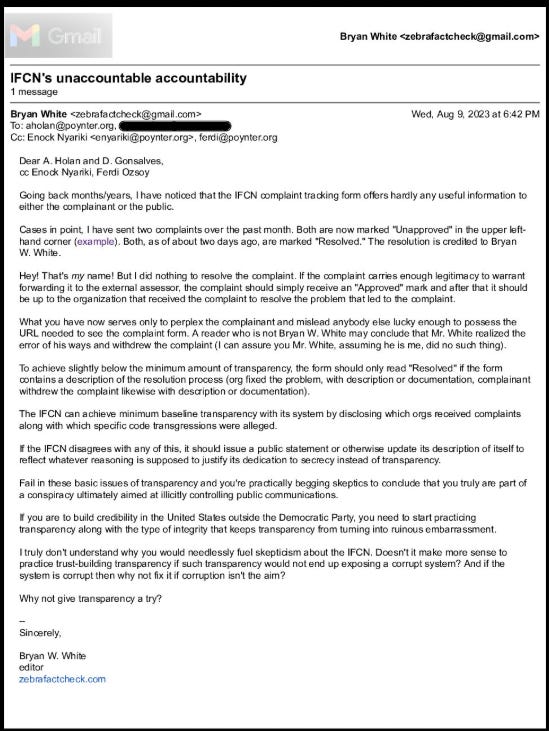
Dear A. Holan and D. Gonsalves,
cc Enock Nyariki, Ferdi Ozsoy
Going back months/years, I have noticed that the IFCN complaint tracking form offers hardly any useful information to either the complainant or the public.
Cases in point, I have sent two complaints over the past month. Both are now marked “Unapproved” in the upper left-hand corner (example). Both, as of about two days ago, are marked “Resolved.” The resolution is credited to Bryan W. White.
Hey! That’s my name! But I did nothing to resolve the complaint. If the complaint carries enough legitimacy to warrant forwarding it to the external assessor, the complaint should simply receive an “Approved” mark and after that it should be up to the organization that received the complaint to resolve the problem that led to the complaint.
What you have now serves only to perplex the complainant and mislead anybody else lucky enough to possess the URL needed to see the complaint form. A reader who is not Bryan W. White may conclude that Mr. White realized the error of his ways and withdrew the complaint (I can assure you Mr. White, assuming he is me, did no such thing).
To achieve slightly below the minimum amount of transparency, the form should only read “Resolved” if the form contains a description of the resolution process (org fixed the problem, with description or documentation, complainant withdrew the complaint likewise with description or documentation).
The IFCN can achieve minimum baseline transparency with its system by disclosing which orgs received complaints along with which specific code transgressions were alleged.
If the IFCN disagrees with any of this, it should issue a public statement or otherwise update its description of itself to reflect whatever reasoning is supposed to justify its dedication to secrecy instead of transparency.
Fail in these basic issues of transparency and you’re practically begging skeptics to conclude that you truly are part of a conspiracy ultimately aimed at illicitly controlling public communications.
If you are to build credibility in the United States outside the Democratic Party, you need to start practicing transparency along with the type of integrity that keeps transparency from turning into ruinous embarrassment.
I truly don’t understand why you would needlessly fuel skepticism about the IFCN. Doesn’t it make more sense to practice trust-building transparency if such transparency would not end up exposing a corrupt system? And if the system is corrupt then why not fix it if corruption isn’t the aim?
Why not give transparency a try?