

We contacted Media Bias/Fact Check’s creator, Dave Van Zandt, for background information contributing to our commentary article “Media Bias/Fact Check Blinded by Science Feedback.”
[Our outreach, and Van Zandt’s response:]
ZFC:
I apologize for misunderstanding the function of the MB/FC feature allowing readers to point out where an organization failed a fact check. That feature of MBj/FC is useless on pages reviewing IFCN signatories (or fact check organizations in general) because they do not fact check one another. It’s probably something to do with professional courtesy, though it’s a poor service to the public when the fact checkers disagree with each other (or even with themselves, as I’ve documented PolitiFact doing from time to time).
And with that out of the way, I’m writing up an article about your article on Science Feedback.
I have two questions I’d like for you to consider addressing, for publication. I’ll remind you that ZFC policy will make my questions and your responses available to readers in full regardless of what I choose to use in the article.
What evidence supports the claim “The website is free from editorial bias”?
Could readers be misled by MB/FC’s claim that Science Feedback has never failed a fact check, given that fact checkers do not fact check other fact checkers (I think ZFC is the lone exception)?
DVZ:
I hope you and your family are doing well during this crazy time. I would be happy to answer your questions. Science Feedback does not produce op-eds or offer news articles that are opinion-based. They simply publish fact checks related to climate change and health. This does not mean they are free from bias. We have rated them pro-science, which one could argue states they have a pro-science bias.
You are correct. It does seem that the IFCN fact-checkers do not fact each other. I think you sent me some information via our contact form regarding a poor fact check by Science Feedback. I have not had a chance to look at it, but plan to do so and if the information is strong I will be adding it to the Science Feedback review and potentially changing their rating. I think it would be worthwhile to include non-IFCN fact-checkers criticism as well, to paint a more clear picture. I hope this helps.
ZFC:
Thanks for the prompt reply. I have one follow-up question that I hope you will consider answering.
PolitiFact’s creator, Bill Adair (now at Duke University) published an article in Columbia Journalism Review stating in no uncertain terms that there is a continuum of journalism that corresponds to the amount of bias. Adair even says “Bias is good.”
Here’s the chart published along with his article:
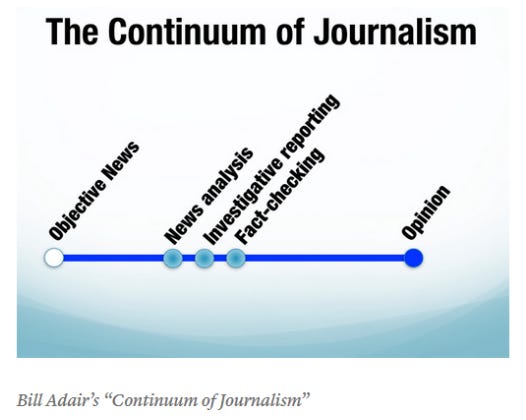
Where do we draw the line between good bias and bad bias? Or is there any useful distinction between the two?
DVZ:
That was a good article. I tend to agree with Mr. Adair on most points. Before drawing the line between good bias and bad bias we have to recognize that each person is biased in some way. This is why we label sources as least biased vs. non or unbiased. Personally, the line between good bias and bad bias is where the context becomes highly misleading, the facts are cherry-picked from one perspective and/or the information presented is verifiably false with the intention to mislead the media consumer. Bad bias misleads and uses strong emotions, whereas good bias presents evidence to support an opinion and offers a reasonable contrasting viewpoint, etc.
ZFC:
Thanks again for a prompt reply. Cheers.
Here’s another article you might like:
PolitiFact is not biased -- here’s why